Before You Buy Home Air Conditioning: A British Reality Check
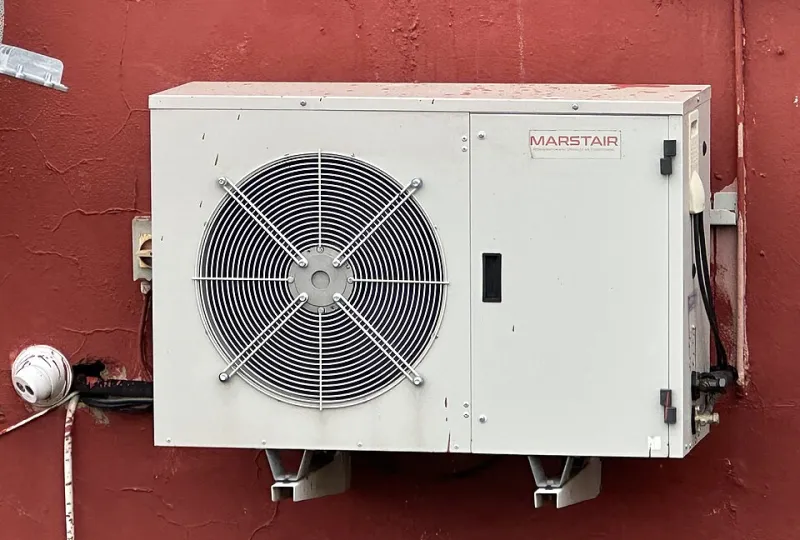
Photo: OathOn, CC BY-SA 4.0, via Wikimedia Commons
Every American film set in a suburb has the same background noise: a window unit rattling away, a wall-mounted head blowing cold air at a sofa, a thermostat set to something punishing. It has become the shorthand for what cooling looks like. It is also, almost entirely, the wrong template for a British house.
Here is the reality check. The UK does not have a Florida summer, most homes do not have ductwork, and a hot spell that lasts four days does not justify the same system as a climate that runs at 35 degrees for four months. But recent summers have been genuinely uncomfortable, the 40.3 degrees recorded in July 2022 was not a freak event so much as a marker on a warming trend, and more people than ever are asking whether they should do something about the box room that turns into an oven.
The answer is usually yes. It is rarely the answer you would guess.
The all-or-nothing myth
Two camps dominate the conversation. One says air conditioning is an American indulgence, ruinously expensive and pointless in a country where it rains in August. The other says you need a full multi-room system or you may as well not bother.
Both are wrong. The useful framing is the one you would use for a car: you do not buy a van because you once moved a sofa. You buy the smallest thing that solves the actual problem, for the rooms you actually use.
So decide first what you are cooling. A bedroom you cannot sleep in during a hot spell is a very different brief from a south-facing home office that hits 30 degrees by eleven in the morning and stays there.
Before you spend a penny, spend a Saturday
Cooling a room that is being cooked by the sun is an expensive way to fight physics. Louvred shutters, external blinds, an awning, a well-placed deciduous tree on the south-west corner, or even a reflective film on a velux will do more for a loft conversion than a portable unit ever will. Deal with the heat gain before you add the cooling.
Then look at air movement. A decent pedestal fan uses about forty watts and costs pennies an hour. Cross-ventilation at night, where you have windows on opposite sides of the house, flushes heat out of the structure far more effectively than a fan blowing warm air round a sealed room.
And if your home already has mechanical ventilation with heat recovery, check whether it has a summer bypass. Plenty do, and running it on boost overnight pulls cool air through the property for little more than the cost of a small fan.
If, after all that, the room is still unbearable for a fortnight a year, you are now shopping with a clear head.
The realistic options
Portable units
Three to six hundred pounds, no installation, and a hose hanging out of the window. The catch is that the hose is dumping hot air outside while the unit drags replacement air in from wherever it can, including back through the window you just opened. Efficiency suffers, and the compressor is loud enough, at fifty to sixty-five decibels, that you will struggle to sleep beside it. Fine as a stopgap for one brutal week, or for a rented flat where you cannot fit anything permanent. Not a long-term answer.
Single split systems
One indoor head on the wall, one outdoor unit on a bracket or a ground plinth, a short pipe run through the wall and a condensate drain. Budget roughly twelve hundred to two and a half thousand pounds installed for a typical bedroom or living room. Indoor noise drops to around twenty to twenty-five decibels on the low setting, which is quieter than a fridge. For most UK homes this is the sweet spot: one room, done properly, with a remote or an app you can use to pre-cool before you get home.
Multi-split systems
One outdoor unit feeding two to five indoor heads. Three to six thousand pounds and upwards, depending on room count and how awkward the pipe routes turn out to be. Worth it if you want a bedroom and a living room cooled and only have one sensible place for the condenser. Be aware that running a single head on a multi-split is usually slightly less efficient than a dedicated single split, and that planning the pipework matters more than the hardware.
Ducted and ceiling cassette options
Realistically for renovations, lofts and new builds. If the ceiling is coming down anyway, a slim ducted unit hidden above it is the tidiest result available. If it is not coming down, forget it.
Noise: the part nobody mentions
The indoor unit is quiet. The outdoor unit is the one that matters, and it is usually sited exactly where it will irritate someone: under a neighbour's bedroom window, on a party wall, or on a bracket that turns vibration into a drum.
Ask for the sound power level in decibels, not the vague 'quiet operation' line in the brochure. Mount the unit on rubber anti-vibration feet rather than hard brackets, and keep it away from the fence line if you can. Most decent units have a night mode that drops fan speed and noise along with it.
Planning permission and the neighbourly question
In England, many single domestic installations fall within householder permitted development, but the conditions are specific about position, size and the noise the unit emits. Flats, listed buildings and conservation areas generally need a formal application. Scotland, Wales and Northern Ireland run their own rules. A five-minute call to the local planning department before you order anything is cheaper than a retrospective application.
Then there is the informal permission: tell the neighbour. A condenser humming outside their kitchen window in August is exactly the sort of thing that becomes a council complaint. A short conversation in advance, and a siting decision that takes their bedroom into account, prevents almost all of it.
What it costs to run
Use your own tariff, but the shape of the maths is this. A 3.5 kW split draws around a kilowatt while it is running. At roughly 25p per kWh, six hours a day across a two-month hot spell lands at something like ninety pounds. That is not nothing, but it is a long way from the mortgage-wrecking figure people imagine. What it will not do is cool a whole house: leave the doors open and you are paying to cool the hallway and, eventually, the street.
Reversible units: a genuine UK argument
Most splits sold today are reversible, meaning they heat as well as cool. In spring and autumn, an air-to-air heat pump is a very efficient way to take the chill off a room without firing the boiler. In the depths of January the economics are less flattering, because electricity costs several times what gas does per kilowatt hour. If you have solar panels and a battery, the arithmetic swings firmly in your favour. Treat heating as a bonus rather than the reason you buy.
Questions to ask before you sign
- How did you calculate the size, and did you use the room's heat gain rather than its floor area?
- Where does the condensate go, and will it stain the wall or freeze in winter?
- What is the sound power level of the outdoor unit, in decibels?
- Are you F-Gas certified, and who services the system in three years' time?
- What happens to my warranty if I use another firm for servicing?
- Exactly where will the pipes run inside, and can I see that route before you cut?
The sensible conclusion
For most British homeowners the right sequence is shading first, ventilation and fans second, and a single split in the one room that genuinely ruins your summer third. That is not a compromise. It is simply a better match for the climate, the housing stock and the electricity bill than a four-head system pretending we live in Arizona.
Cool air when you need it, and a sensible bill when you do not. That is the whole brief.