A Diary in Grey and Yellow: Reading What Your Air-Con Filter Has Collected
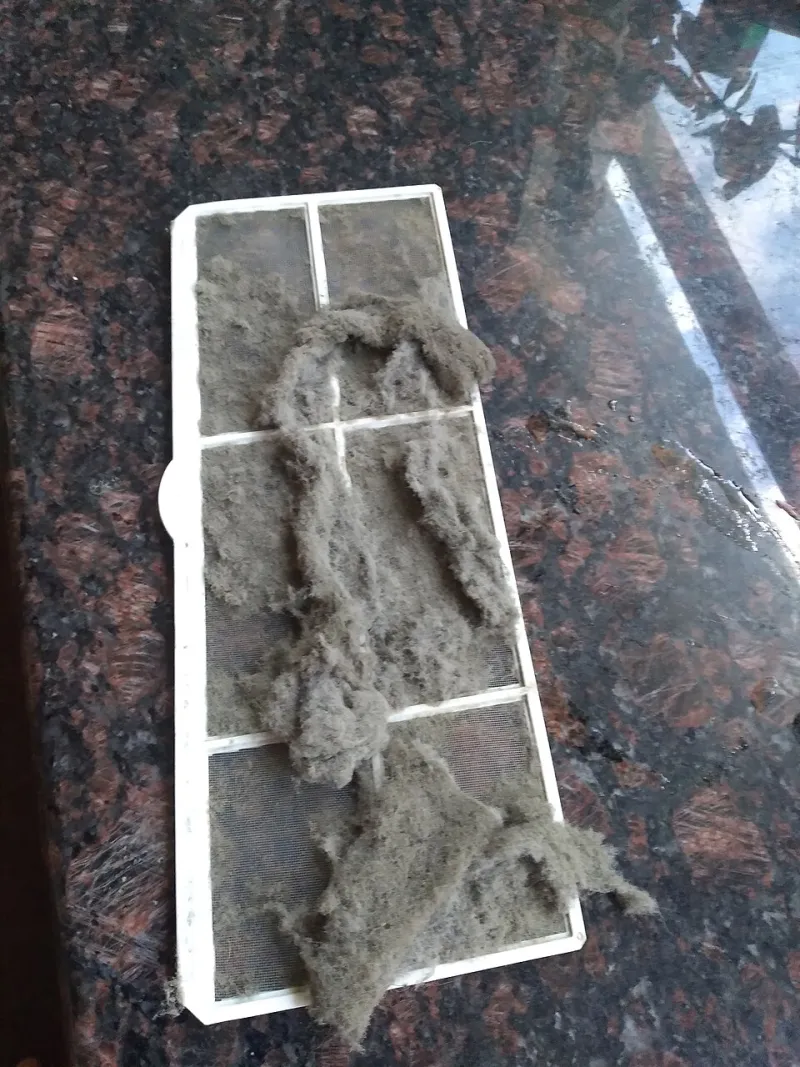
Photo: Gerardolagunes, CC BY-SA 4.0, via Wikimedia Commons
Most people look at a grubby air-con filter and see one thing: a job they should have done sooner. Look a little closer and it becomes something more useful. A filter is a record of everything that has drifted through your rooms for the last few months — and the shade and texture of what is caught in it varies considerably from one house to the next.
What a filter is actually doing
The mesh panel behind the front grille of a split system is a fairly coarse screen. It is not a HEPA filter and it is not an air purifier; its main job is to stop dust and debris clogging the fins of the indoor coil behind it. Some units add a thin carbon or enzyme layer, but the washable mesh is the workhorse, and it is the part worth paying attention to.
Because that mesh sits in a room breathing the same air you do, it acts as a passive sampler. Change or clean it on a schedule and you get a running series of snapshots, season after season.
Reading the traces
Grey-black, fine and slightly oily
Soot from vehicle exhaust and, in older houses, whatever the wood burner or open fire is sending up the chimney. If your filter goes dark noticeably faster than a friend's a few streets away, you are probably on a busier road than you think, or the prevailing wind carries the traffic plume past your windows. It is common on upper floors facing a main road, where the air is a little more mobile.
Pale, floury and even
Skin cells, plaster dust, textile fibres and general household debris. Almost every filter has some of this. If it is the dominant deposit and appears within a few weeks, look at what is shedding — new carpet, a recently skimmed wall, or a loft hatch that does not seal.
Yellow-green in spring and early summer
Grass and tree pollen. Birch, oak and grass all peak at different points between March and July, and a bedroom unit running overnight will collect a visible tint. If you suffer from hay fever and the filter is showing this clearly, it is telling you the unit is doing useful work — and that it needs cleaning more often during that window.
Black speckling with a musty smell
This is the one to take seriously. Dark patches plus a damp, cellar-like odour usually point to mould spores being drawn through the unit. The cause is nearly always in the room, not the machine: condensation on a cold external wall, a bathroom door left open, or a bedroom where the window is never opened because of the noise outside. Cleaning the filter helps; fixing the moisture source helps more.
Sticky film and a faint cooking smell
Grease. An air-con unit in or near a kitchen, or in an open-plan living space where the hob is a few metres away, will pick up an invisible cooking aerosol. It clings, it holds dust, and it makes the mesh much harder to clean properly. Worth checking monthly in that situation.
Room-by-room clues
Bedroom. Watch for pollen in early summer and fine dust in winter. A dark filter in a room that never has its window open is usually a sign you are recirculating the same air rather than freshening it.
Living room. Sooty grey in urban terraces, especially near a fireplace or wood burner. Also the first place to show fibre dust if you have soft furnishings or heavy curtains.
Home office. Surprising amounts of paper and toner dust, plus a lot of skin cells from long days at the desk. Units here often run long hours, so filters load up faster than you expect.
Any room facing a main road. Expect a faster build-up overall, and expect to clean the filter roughly twice as often as the manual suggests.
A seasonal filter routine that actually sticks
You do not need a spreadsheet. You need three moments in the year.
- Start of the cooling season (late spring). Give the mesh a proper wash. Vacuum first with a soft brush, then rinse under warm water with a drop of washing-up liquid. Rinse from the clean side through so you push debris out rather than in.
- Mid-season glance. Once a month, slide the grille open just to look. If the mesh is visibly grey across the whole panel, clean it. If you can see through it, leave it.
- End of season (autumn). Clean it before the unit goes quiet for the winter. A filter left loaded with damp dust over the colder months is where smells start.
Always let the mesh dry completely — flat and in air, not in the sun's full blaze — before it goes back in. That is the single most common mistake, and it is the reason some people get a musty whiff for weeks afterwards.
If the air is a concern, filters are only half the answer
For allergy sufferers, city dwellers, or anyone whose house sits near a busy junction, a clean filter is a genuine help — but it is not a substitute for ventilation. A recirculating air conditioner does not bring fresh air in. If your windows are never opened because of traffic noise, the dust in the filter is a fair picture of what you are breathing all evening.
That might mean a trickle vent, a window restrictor that lets air in but noise out, or a mechanical ventilation system with a proper filter on the intake. The air-con filter will tell you when it is time to think about that. It just will not fix it on its own.