Decibels Before Decisions: Choosing Air-Con You Can Live With
Photo: Rasevic, CC BY 3.0, via Wikimedia Commons
Most air-con buying conversations start with cooling capacity, energy labels and price. Noise often comes last, if it comes up at all. Then the unit goes in, the first warm night arrives, and every little hum, rattle and fan whistle becomes the most important feature in the room. In UK homes, where bedrooms can be compact and gardens can be close to a neighbour’s wall, peace and quiet is not a luxury extra. It is part of the comfort you are paying for.
What the dB(A) figure actually tells you
Air-con noise is usually quoted in dB(A). The A-weighting bit is meant to reflect how human ears perceive sound, but the number still needs context. Manufacturers often quote indoor sound pressure at one metre, sometimes on a low fan setting, sometimes not. Outdoor units may be quoted as sound power, which is not directly comparable with a sound pressure figure taken beside an indoor head.
That matters because a number can look wonderfully low on a spec sheet and still feel noticeable in a quiet bedroom. A small room at night might have a background level of 25 to 30 dB(A). A unit rated at 19 dB(A) can be very quiet, but it will still be audible in near silence. A unit at 30 dB(A) may disappear into daytime traffic noise and then feel much louder at 2am. Compare like with like, and ask which fan setting and which distance the figure refers to.
Bedrooms: sleep mode is more than a button
Sleep modes vary enormously. Some reduce fan speed and dim the display. Some also let the room drift slightly warmer through the night. Others add a quiet night-time setting that is genuinely useful. The detail is in the small print, not the icon on the remote.
Think about where the indoor unit will sit. Directly above a headboard is rarely a good idea, even with a quiet unit. A wall that backs onto a neighbour’s bedroom deserves extra thought. In smaller British bedrooms, sound bounces off hard surfaces, so curtains, rugs and a well-placed wardrobe can make a room feel calmer without changing the machine at all.
Ask to hear the unit in night mode if you can. If that is not possible, ask for the night-time sound pressure figure at one metre. Check whether the display can be switched off and whether the unit beeps loudly every time somebody touches the remote. These are the tiny details that decide whether a good system feels intrusive.
Outdoor units: the neighbour question
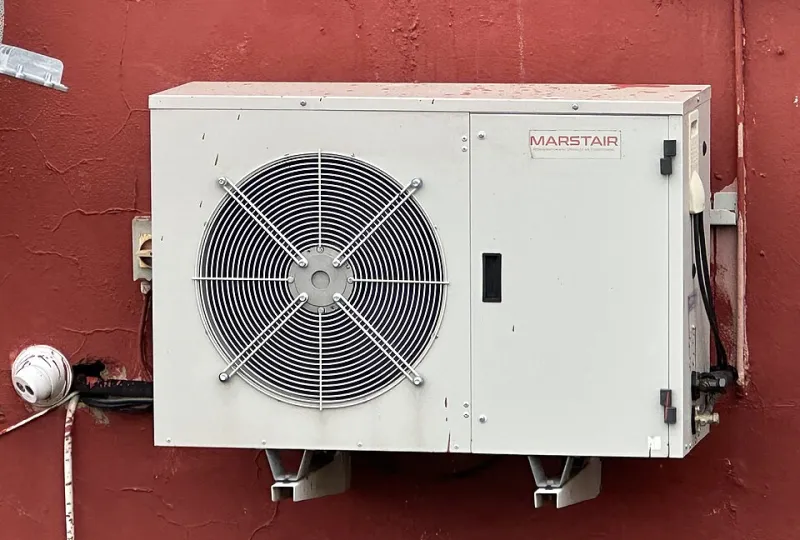
The outdoor unit is often the real noise story. It may sit below a window, beside a boundary, on a shared wall or in a narrow courtyard where sound has nowhere to go. A figure that seems fine in open air can behave differently when the unit is tucked into a corner.
Ask where the condenser will go before you sign. A sensible installer will think about the rooms on the other side of the wall, the nearest neighbour’s windows, and how sound will travel around the building. Anti-vibration feet and brackets are not glamorous, but they can make a real difference. So can leaving enough space for airflow rather than boxing the unit into a tight gap.
Noise from equipment can become a neighbour nuisance issue, and planning rules for outdoor units are not identical everywhere. If you live in a flat, a listed building or a conservation area, check the permissions position early. That is not about spoiling the project. It is about avoiding an expensive rethink after the brackets are already on the wall.
Vibration and the building itself
Two units with similar decibel ratings can sound different because of the building. A bracket fixed to a lightweight partition can transfer vibration. A loose panel can rattle. A badly seated unit can develop a buzz that no spec sheet warned you about.
Ask what mounting kit is included and whether the installer will check for vibration at commissioning. Rubber pads, proper brackets and a bit of care with fixings are small costs next to the price of the system. If the outdoor unit is going on a wall, ask whether a ground-mounted option is possible instead. Sometimes a metre of extra pipework buys a lot of goodwill.
Questions to ask before you commit
A short list cuts through the marketing:
- What is the indoor sound pressure at one metre on high, low and night mode?
- What is the outdoor unit’s sound power figure, and where exactly will it sit?
- Which rooms and windows are on the other side of that wall?
- Are anti-vibration mounts included as standard?
- Will the installer commission the system and check for rattles or vibration?
- Can I hear a similar unit running before I decide?
The shortlist test
If two systems are close on price and efficiency, let noise break the tie. Do not oversize the unit just because bigger feels safer. An oversized system can short-cycle, switching on and off more often, and fan noise may become more noticeable. A well-matched inverter unit running steadily is often easier to live with than a larger one doing short, sharp bursts.
Peace and quiet is not an afterthought in home comfort. It is part of the experience, especially in a British home where rooms are close together and windows are often open in summer. Put decibels on the shortlist early, and the system you choose is far more likely to feel welcome once the novelty of the remote control has worn off.